
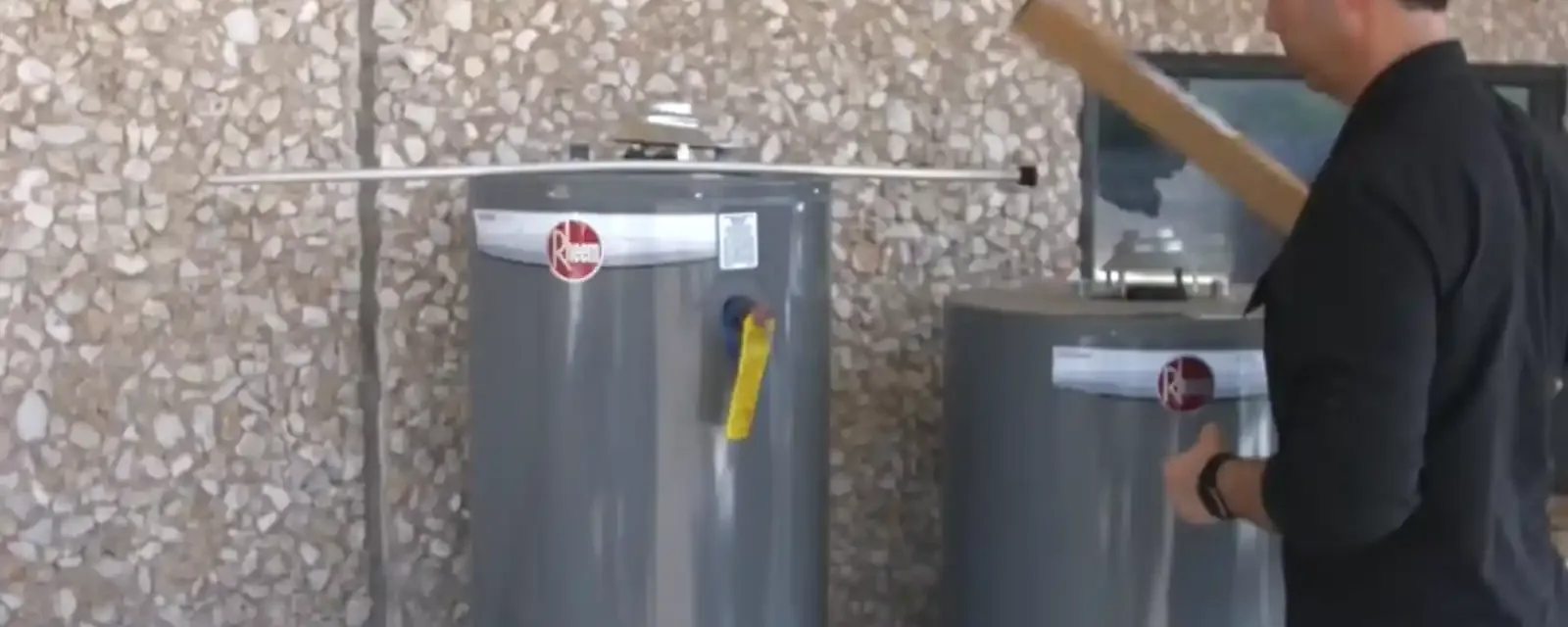
When a tank splits open, the water keeps coming until someone shuts it off. Georgetown 24/7 Plumbing dispatches around the clock for water heater replacement in Georgetown, KY, and across Scott County. Water heater replacement means removing the failed unit, setting a new one, reconnecting water, gas or power, venting, and the safety valves, then testing it.
Shut the supply valve on top of the tank right now, then drop the breaker or set the gas control to off. Keep children and pets out of any room with standing water and live outlets. Then call. If the tank only has a small fitting leak, our repair service may be the cheaper answer, and we will say so.
Failed tank flooding the floor? What to do first
These four moves limit the damage while a plumber is on the way. Evening, overnight, and weekend calls follow the same order.
Stop the water
Turn the cold supply valve above the tank to closed. If it will not turn, shut the main valve for the house.
Kill the fuel or power
Switch off the dedicated breaker, or set the gas control to off. Do not step into standing water to reach a panel.
Smell gas? Leave
Walk everyone outdoors, then ring the Columbia Gas of Kentucky emergency line or 911. A plumber comes after the gas utility has cleared the house.
Move what you can
Lift boxes, rugs, and electronics off the floor. Photograph the tank and the damage for your insurer.
Leaking tank: repair it or replace it?
Where the water comes from decides the answer. A weeping fitting, drain valve, element gasket, or relief valve can be fixed on the existing tank. Water from the seam between the jacket and the base, or rust-streaked water at the bottom of the shell, means the steel has corroded through. No patch holds there, and the tank should come out.
Age and history matter too. The rating plate lists the manufacture date. A tank that has needed repeated work, rumbles from heavy scale, or has a warranty that already ran out leans toward replacement even when the current leak is small. A tank with a loose fitting and a young date is usually worth repairing.
If water keeps appearing after you replace a tank, the source may be somewhere else entirely, such as a supply line in the wall. That is where leak detection earns its keep, before you pay for equipment that was never the culprit.
Water Heater Replacement: talk to a person now
Describe the problem and get a clear price before work starts.
Signs to repair versus signs to replace
Use this list as a first sort. A technician confirms it on site.
Repair is reasonable
- Leak is at a fitting, valve, or element gasket.
- Rating plate shows a young unit.
- No rust at the base of the tank.
- Failure is a single replaceable part.
- Tank has not needed earlier repairs.
Replace instead
- Water seeps from the shell or base.
- Rust-colored hot water.
- Heavy scale and loud rumbling.
- Repeated repairs on the same unit.
- Repair cost approaches a new heater.
Tankless or tank: the decision at a glance
Replacing a failed tank is also the moment to choose a different type. Here is how the main options compare on the points that usually decide it.
| Question | Storage tank | Tankless |
|---|---|---|
| How it makes hot water | Keeps a full tank heated | Heats water as it flows. |
| Hot water in long runs | Limited by tank size | Steady while flow stays in range. |
| Floor space | Needs a floor footprint | Mounts on a wall. |
| Gas and venting changes | Usually matches the old unit | Often needs a larger gas line and new venting. |
| Hard water upkeep | Tank flush | Regular descaling flush. |
| Best fit | Simple swap, tight timeline | Planned upgrade, long showers. |
Our tankless water heater page covers sizing, flushing, and hard water in more detail.
Switching from gas to a heat pump water heater
A heat pump water heater uses electricity to move heat from the surrounding air into the tank instead of burning fuel. The U.S. Department of Energy says it belongs in a space that stays between 40 and 90 degrees Fahrenheit all year, with plenty of air around it. A small closet may not qualify, and the swap from gas also means capping the gas line and adding a dedicated circuit.
What a replacement permit means in Kentucky
The state plumbing regulation, 815 KAR 20:050, treats a swapped heater as permit work. Only a master plumber, or an owner doing the job personally in the house they live in, can obtain it. Fixing leaks, cocks, or valves is exempt. The regulation lists a residential fee of $50 base plus $14 for each added fixture or appliance, and the permit carries five inspections. Check current fees with the state.
Honest note: the permit is the master plumber's responsibility, so a hired plumber should not hand you that paperwork. Ask any contractor for the master plumber's Kentucky licence and permit, then check with the Division of Plumbing. A homeowner permit covers only your own residence, never a rental.
How the replacement visit unfolds
We start by finding the cause, because a shell leak and a failed fitting call for different answers. If the tank has to go, we shut off and drain it, disconnect the water and fuel or power, and carry it out. The new heater goes in on a pan where the situation calls for one.
Next come the connections and the safety devices: shutoff valve, relief valve with its discharge pipe, expansion tank if your meter setup needs it, and a dielectric fitting where steel meets copper. On gas units we check the vent slope and clearances, then test for leaks before lighting the burner.
Last, we set the temperature, check for drips at every joint, and explain what the inspector will look at. After-hours failures follow the same steps, and overnight calls usually end with hot water restored the next morning when parts are on the truck.
If your home is outside the city limits, our service area page shows how dispatch reaches the towns around Georgetown.
What to have ready for the replacement visit
A little preparation keeps a same-day swap on track, including calls that come in after hours.
- Clear a path and a work area around the old heater.
- Photograph the rating plate, the vent, and the shutoff valves.
- Note whether the heater is gas, electric, or has a fan on top.
- Measure the closet or alcove height and width if space is tight.
- Know which utility serves your address, and where the main water shutoff is.
- Tell the dispatcher about any gas smell, scorch marks, or past leaks nearby.
What drives the price of a water heater replacement
A replacement is a quote, not a flat rate. These are the pieces that move the number, and you hear them before work starts.
Homeowners insurance typically covers sudden and accidental damage, like water from a burst tank, rather than wear or maintenance on the heater itself. Ask your insurer what applies to the unit and to the floor damage.
Want your real number? Call (855) 575-2890.
Water Heater Replacement questions answered
Yes. Dispatch runs 24/7, so a tank that fails at midnight or on a Sunday still gets a call-back from a live person. We set same-day appointments when available.
If the tank is leaking, shut the cold supply above it and cut the power or gas control while you wait.
It depends on the source. A fitting or valve leak is repairable. A leak from the tank shell is not, and the tank has to be replaced. Our repair page explains how to tell which one you have.
Yes, the state plumbing regulation lists it as permit work. A master plumber or an owner-occupant can obtain one. When a plumber does the job, the permit is the master plumber's responsibility, not yours.
Often yes, if the space meets the manufacturer's air and temperature needs and an electrical circuit can be added. We look at the location before recommending it. We do not quote rebate amounts.
A straight tank swap is often a single visit. A gas-to-electric change, a tankless upgrade, or a venting fix can take longer. We tell you the plan before work begins and do not promise a clock time.
No. Tankless suits long showers and wall mounting, but it can need gas and venting changes and regular descaling in hard water. A tank is simpler. See the installation page for how planning differs.
Yes. Midway has a page of its own at Midway plumbing service, and the rest of Scott County is covered by the same dispatch.
Where the local facts come from
According to these primary sources, which this page relies on for local facts, permit rules and published guidelines: