
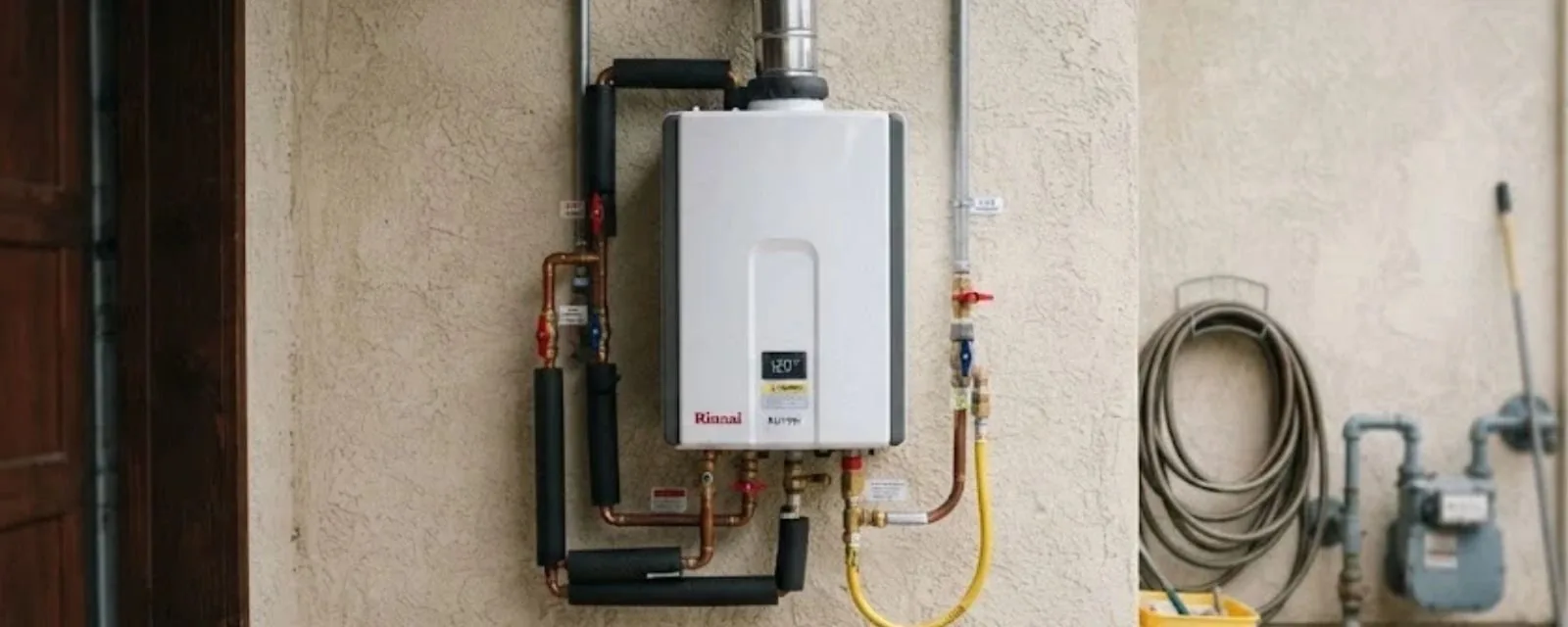
A tankless water heater warms water only while it flows, so it is quick to run out of range and quick to show the effects of scale. Georgetown 24/7 Plumbing installs, services, and flushes every tankless water heater type in Georgetown, KY, and across Scott County. A tankless water heater, also called an on-demand heater, heats incoming water through a heat exchanger instead of storing a hot tank.
If yours shows an error code, goes lukewarm, or sends a burst of cold in the middle of a shower, the cause is often fixable. A failed system can also reach us through 24/7 dispatch. Replacing a tank with a tankless unit is a bigger project, and our water heater installation page explains the planning side.
Cold water sandwich, lukewarm showers, error codes: what tankless service fixes
Homeowners usually describe the symptom, not the cause. This table pairs the common complaints with what the technician checks first.
| What you notice | Common cause | What we check |
|---|---|---|
| Burst of cold between hot water | Short draw or recirculation delay | Flow rate, sensors, and recirculation setup. |
| Hot water runs out in a long shower | Demand exceeds unit capacity | Sizing, fixtures running at once. |
| Error code on the display | Scale, ignition, vent, or sensor fault | The code, heat exchanger, and venting. |
| Lukewarm output | Scale in the heat exchanger or a clogged inlet filter | Descale, inlet screen, and temperature setting. |
| Rumbling or kettle noise | Mineral buildup | Heat exchanger and flow. |
| Gas bill climbed | Scale reducing efficiency | Flush, combustion, and settings. |
Many of these trace back to scale, which is why the next sections matter.
Tankless flush and descaling
A flush circulates a descaling solution through the heat exchanger to dissolve mineral buildup. We close the isolation valves, connect hoses and a pump to the service ports, run the solution for the time the manufacturer specifies, then rinse and restore the valves. The inlet screen is cleaned in the same visit.
Scale acts like insulation on the heat exchanger. The unit works harder, the exchanger runs hotter, and sensors can trip codes before anything has really failed. In hard water, the interval between flushes is shorter than the label suggests, so follow the manufacturer's schedule and check your water.
A flush is maintenance, not a repair. If the exchanger is already cracked, scorched, or leaking, a flush will not fix it, and we tell you plainly. Units without service valves need them added before a proper flush can happen.
Tankless Water Heater: talk to a person now
Describe the problem and get a clear price before work starts.
Tankless water heater sizing and installation facts
A tankless unit is rated by how many gallons per minute it can heat by a given temperature rise. The number that matters is how many fixtures run at once. A shower and a dishwasher together may ask for more than one small unit can give, which is where the lukewarm complaint begins.
Gas units usually need a larger gas supply than a storage tank and their own venting. Electric units draw heavy current, so the panel must have the capacity. Columbia Gas of Kentucky holds the natural gas franchise in Georgetown, so questions about the meter belong with that utility. A tankless install is permit work under the state plumbing code, so the master plumber handles that step.
Where the old tank sat on the floor, the new unit mounts to the wall. That frees space, though the gas, water, and vent connections all move. Planning that on paper first avoids surprise costs.
Why Georgetown's water is hard on tankless heat exchangers
The Georgetown Municipal Water and Sewer Service calls its water extremely hard, because the groundwater collects calcium and magnesium from limestone. Softening at the plant is not part of its treatment, so the minerals reach your heater untouched.
A tankless heat exchanger has narrow passages and runs hot. Scale forms there quickly, and the first sign is often an error code or lukewarm output. A test at your own tap tells you where you stand, and GMWSS can answer questions about its supply.
Softener, scale inhibitor, or filter: what each does for a tankless heater
People bundle all three under water treatment. They do different jobs, and none replaces periodic flushing. We test your water and advise before we recommend anything.
Softener and scale inhibitor
- A whole-house softener swaps hardness minerals for sodium or potassium, so less scale forms.
- A scale inhibitor changes how minerals form, but does not remove them.
- Neither removes chloramine, and softeners need salt, space, and a drain.
- Check resin and inhibitor instructions for disinfectant limits.
- Both reduce scale but flushing is still advised.
Point-of-use or whole-house filter
- Filters target taste, sediment, or chlorine compounds, not hardness.
- Georgetown's water is disinfected with chloramine, which basic carbon removes poorly.
- Catalytic carbon media are made for chloramine, so ask before buying.
- A filter on the heater inlet can catch grit, not scale.
- A drinking-water filter at one tap does nothing for the heater.
Water softener and filtration trade-offs for a tankless home
Softened water protects the heat exchanger, but it adds a tank, salt or potassium to buy, and a drain connection. It also makes some people dislike the feel of the water. We do not push a softener on every home, and we say when a smaller step, such as a scale inhibitor, suits the house better.
GMWSS uses chloramine as its disinfectant, and the utility publishes that in its annual water quality report. Chloramine affects what a filter cartridge can do and how long softener resin lasts, so match the media to it. If you want to know what is in your tap water, the report and a lab test are the right starting points.
On the visit we look at the heater, the water pressure, and any treatment already installed. Then we explain what each option would change and what it would not. You decide, with a clear price before work starts.
Homeowners in Midway can ask about tankless sizing through the same line that serves Georgetown.
Symptom checklist before you call
A few notes help us bring the right parts and tools.
- Write down the brand, model, and any error code on the display.
- Note whether the cold burst happens on short draws or long ones.
- Check that the gas valve and water valves are open.
- Check the inlet screen only if the manufacturer's guide shows how.
- Note when the unit was last flushed, if ever.
- Tell us if the unit has isolation valves for flushing.
- Gas odor? Go outside and phone the gas utility's emergency number or 911 before anything else.
What affects tankless water heater service and install costs
Service and install prices vary with the unit and the house. These are the factors, and you hear the number before work starts.
Homeowners insurance typically covers sudden and accidental damage rather than wear or maintenance. Scale damage and routine flushing are maintenance items, so ask your insurer about your policy.
Want your real number? Call (855) 575-2890.
Tankless Water Heater questions answered
That is the cold water sandwich. Hot water already in the pipes gets used, then cold water travels through before the unit fires again. A short flow gap, a low flow rate, or scale can make it worse. A recirculation setup or a service visit can help.
Usually the unit is asked to heat more flow than it can handle, or scale is limiting output. We check sizing, fixtures running at once, and the heat exchanger.
Follow the manufacturer's schedule, and expect to flush sooner than the label suggests. GMWSS calls its water extremely hard, and scale builds faster with that kind of water.
It depends on the brand. Codes can point to scale, ignition, venting, or a sensor. Read the code and the manual, and call us if it keeps returning. A gas odor means going outdoors and calling the gas utility or 911 first.
Not always. A softener reduces scale, but it adds salt, space, and a drain connection. We test the water and explain the options before recommending one.
No. Filters trap particles or certain compounds, not hardness. Georgetown's chloramine also needs the right media. Ask us before buying cartridges.
Yes, after checking gas line size, venting, panel capacity, and permit needs. See our replacement page for the tank-versus-tankless table, and the service area page for coverage.
Where the local facts come from
According to these primary sources, which this page relies on for local facts, permit rules and published guidelines: