
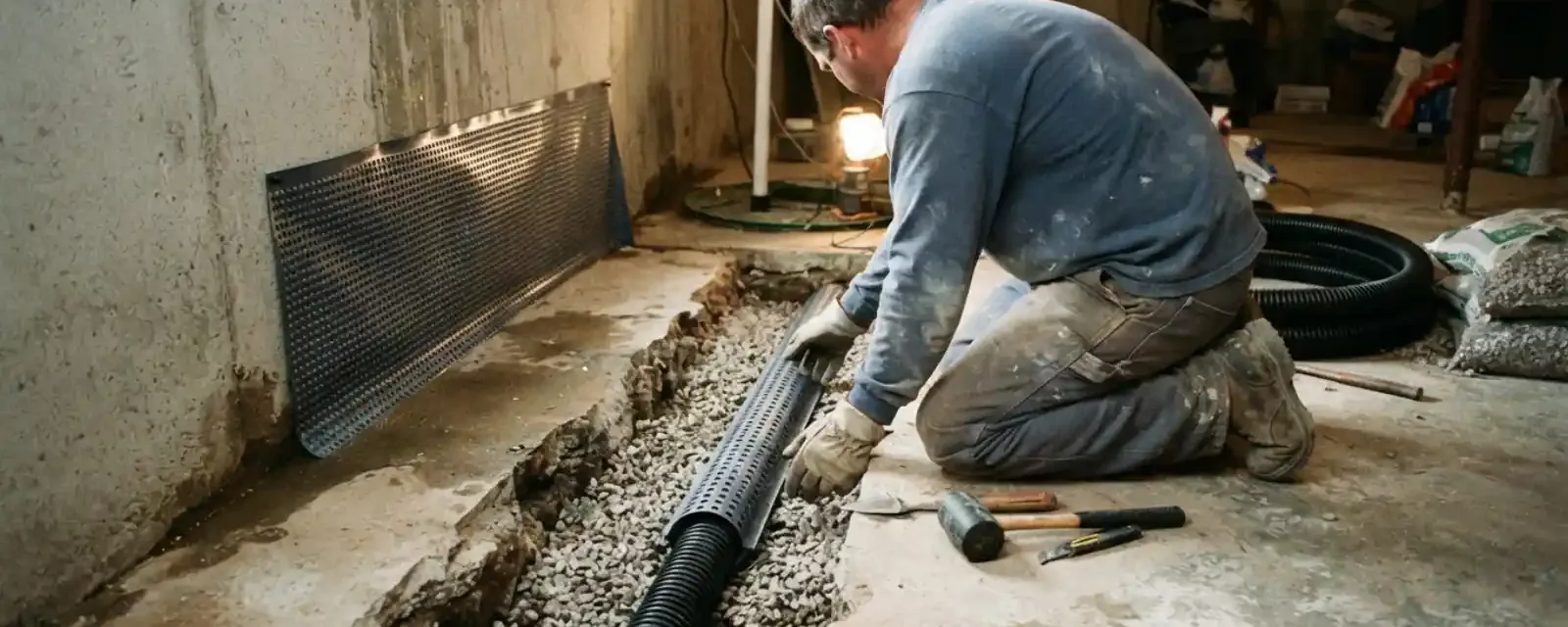
New construction basement waterproofing in Georgetown, KY means checking and protecting a lower level that is still young, ideally before moisture shows up. Basement waterproofing is the set of drainage, sealing and water-removal measures that keep groundwater out of a below-grade space. Newer homes in subdivisions such as Falls Creek are not exempt, because the limestone ground under Scott County moves water in ways a builder's grading plan cannot fully control.
This guide is for buyers and builders. It explains what to inspect, which problems belong to a plumber and which belong to a foundation specialist, and when to involve the builder's warranty. Our basement waterproofing page covers the plumbing-side work in more detail.
Six places to look in a newer basement
A walk-through takes a few minutes and often shows the early signs of a water problem.
Floor-wall joint
A damp line, white mineral crust or a hairline gap where the slab meets the wall can show water finding a path.
Floor drain
Check that it is open, that water reaches it, and that the trap holds water.
Sump pit
If the house has one, look for a clean pit, a working float and a discharge pipe that carries water away from the foundation.
Window wells
Debris and poor drainage fill these quickly after heavy rain.
Grading outside
Soil should slope away from the walls. Settling after construction can reverse that.
Downspouts
Extensions that dump water beside the foundation load the ground with more water than it can drain.
Plumber or foundation specialist: who handles what
Honest scope matters here. A plumber is the right call for some basement water and the wrong call for others.
Plumber
- Sump pump and discharge piping.
- Floor drains and interior drain connections.
- Water supply or drain leaks inside the walls.
- Backwater and sewer-related problems.
Foundation or waterproofing specialist
- Cracks in poured or block walls.
- Exterior membrane and sealing.
- Grading and exterior drainage design.
- Structural movement or settlement.
Rather have a licensed plumber look at it?
Call the 24/7 line. You get a clear price before work starts.
Why a newer house can still take on water
Fresh backfill around a new foundation settles over the first seasons. As the soil sinks, it can create low spots that hold rain next to the wall. A lot graded correctly on closing day may not drain well a few years later.
Builders also work from an average soil picture, while real ground has surprises. In a limestone region the surprises include fractured rock and underground water paths that do not follow the surface slope.
If a basement feels damp in its first year, document it right away. Date photos, rainfall notes and the spot on the wall give you the record you need for any builder conversation.
Symptoms, likely cause and likely first call
Use this as a starting guide, not a diagnosis. Some problems overlap.
| What you see | Possible cause | First call |
|---|---|---|
| Damp patch after heavy rain | Grading or downspout discharge | Builder or grading contractor. |
| Water at the floor-wall joint | Hydrostatic pressure or poor drainage | Waterproofing specialist. |
| Standing water in the sump pit | Pump problem or high groundwater | Plumber. |
| Wet spot with no rain | Supply or drain leak in the wall or slab | Plumber, with leak detection. |
| Stair-step crack in block wall | Settlement or lateral pressure | Foundation specialist. |
A leak with no rain nearby often points to pipes, not ground water.
Before you buy or sign off on a newer home
These steps help catch a water problem while the builder is still responsible.
- Visit after a heavy rain if you can, and look at the basement afterward.
- Ask whether the house has a sump pit, a drain tile system or a floor drain.
- Check the downspouts and where they discharge.
- Look for efflorescence, the white powder left on concrete by evaporating water.
- Ask what the builder's warranty says about water and cracks.
- Save the inspection report and dated photos.
- Call Kentucky 811 before any digging or trenching, including drainage work.
When to call a licensed plumber
Call a plumber if water appears with no rain, if a sump pump runs without stopping, or if you smell sewage near a floor drain. Those point to pipes or drains, which a plumber can test. A hidden supply leak is something our leak detection work is built to find.
Call a foundation specialist for wall cracks, bowing or exterior sealing. If you are not sure which, a plumber can rule out the plumbing first and tell you honestly when the next step is not ours. We serve Georgetown and nearby towns, including the Midway area, and our service area page lists the rest.
Georgetown, KY local note: limestone ground and rain
The Kentucky Geological Survey explains that karst forms on limestone where groundwater dissolves the rock. Sinkholes and swallow holes carry surface water underground, and many towns were founded at karst springs. Georgetown's Royal Spring is one of them, and the town sits in the Bluegrass limestone region. Water below a Georgetown basement may travel along paths that grading plans never mapped.
The practical result is seepage, wet crawlspaces and groundwater in lower levels. Where a sump pump discharges also matters, because sewage, oil and other pollutants entering karst are not filtered. Ask the plumber where discharge water should go, and keep it away from the foundation and out of the sewer line.
Rain adds to the load. NWS climate normals for Lexington, the nearest climate station, list roughly twelve days in a typical year when an inch or more of rain falls. A basement that stays dry through light rain may still leak on those days, so test the house after a heavy rain. Before any trench or drain is dug, call Kentucky 811.
Questions readers ask
It should not. Moisture in the first year is worth documenting and reporting to the builder. Some dampness is curing concrete, but standing water or repeated wet spots are not normal.
Not every house has one. Whether yours needs one depends on the site and drainage. If water collects in the lower level, a plumber can assess whether a pit and pump make sense.
A plumber handles interior drainage, sump systems and pipe leaks. Exterior membranes, wall repair and regrading belong to waterproofing and foundation specialists. We will tell you which side your problem is on.
It is called efflorescence, mineral left behind as water moves through concrete and evaporates. It signals moisture passing through the wall, not necessarily a leak, so track whether it grows.
Warranty terms vary, so read yours and ask the builder. Insurance typically covers sudden damage, not slow seepage, so your homeowners policy may not respond to gradual water entry.
It can. The Kentucky Geological Survey describes Georgetown as sitting on Bluegrass limestone where groundwater moves underground through dissolved rock. That is a reason to check drainage and sump discharge in any lower level, even in a newer home.
Where the local facts come from
According to these primary sources, which this page relies on for local facts, permit rules and published guidelines: