
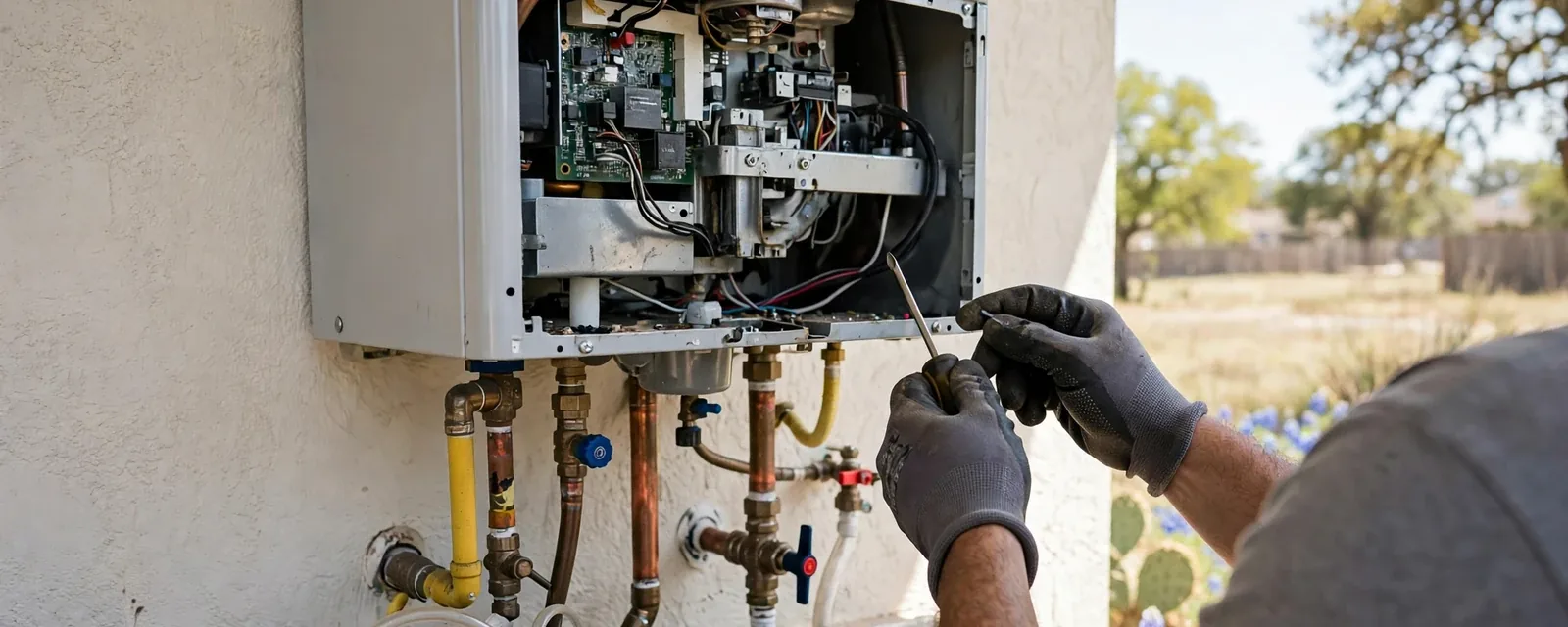
An 18 kW electric tankless water heater can supply hot water for a small to mid-size household, but it will not run every fixture at once in cold weather. The kilowatt number tells you how much heat the unit can add each second, and that heat is shared between how much water flows and how many degrees it must rise. For a home in Georgetown, KY, the winter inlet temperature is usually the limiting factor.
An electric tankless water heater is a wall-mounted unit that heats water only while a tap is open, using electric elements and no storage tank. This post explains how to read the 18 kW rating, how flow and temperature rise trade off, and what to ask an installer before you buy.
What 18 kW actually means
A kilowatt is a measure of power. An 18 kW unit can convert up to 18 kilowatts of electricity into heat while water flows through it. It does not store anything, so every gallon you use is heated on demand, and the heater works hardest when the water entering is cold.
That power draw is large for a household circuit. As raw arithmetic, current equals watts divided by volts, and 18,000 watts on a 240-volt supply works out to about 75 amps, before any safety margin. The actual circuit, breaker and wire size for a given model comes from the maker's installation manual, so ask the installer for the exact circuit requirement from the manufacturer's manual and a licensed electrician to confirm your panel can carry it.
Sizing decision table
This table is a rough sorting tool, not a sizing calculation. Your plumber will confirm with the manufacturer's flow charts for your inlet water temperature.
| Household pattern | Likely fit for 18 kW | What to ask the installer |
|---|---|---|
| One or two people, one shower at a time | Often a good match | Does it keep up with a winter shower plus a running sink? |
| Family of four, showers back to back | May work with scheduling | What flow rate does the chart show on my coldest days? |
| Two showers plus dishwasher at once | Often falls short | Would two smaller units or a larger model fit better? |
| Large soaking tub fills | Usually too slow | Is a tub filler worth sizing the whole system around? |
| Panel with little spare capacity | Needs a panel check first | Can the service handle the added load or need an upgrade? |
If you are unsure, bring a list of the fixtures you run at the same time and let the installer size from that.
Rather have a licensed plumber look at it?
Call the 24/7 line. You get a clear price before work starts.
Flow versus temperature rise
Temperature rise is the number of degrees the heater adds to the incoming water. With fixed power, more flow means less rise. If you open a second shower, each stream gets a smaller share of the heat, and the water coming out gets cooler.
Manufacturers publish charts that show the flow rate an 18 kW unit supports at different rises. Read those charts using your coldest inlet temperature, not an average. The point is a hot shower on a January morning, not a pleasant one in April.
Why winter changes the answer
Water in the buried service line comes into the house colder in winter, and the Lexington climate normals show roughly 90 days a year with lows at or below freezing. A tankless unit that handles summer flow easily may deliver warm, not hot, water when the inlet is at its coldest.
If you want one answer for the whole year, size for the cold month. Ask the installer what flow the unit sustains at your winter inlet, then compare it to the sum of fixtures you actually run together.
Scale on electric elements
Electric tankless units pass hard water across heating elements, and minerals in the water build up there as scale.
What scale does
- Coats elements so they heat less efficiently.
- Can trigger error codes or reduced output over time.
- Restricts small passages inside the heat exchanger.
- May shorten the life of a unit that is never serviced.
What helps
- Testing your tap water before choosing a unit.
- Considering a water softener or scale-control device upstream.
- Scheduling periodic descaling, as the manual directs.
- Cleaning inlet screens when flow drops.
Questions to ask before you buy
Take this list to any installer, including us.
- Which exact model, and what is its listed flow at my winter inlet temperature?
- What circuit does the manufacturer's manual call for?
- Does my electrical panel have room for it?
- Who pulls the plumbing permit?
- What scale protection or descaling plan fits my water?
- What happens to my old tank, vent and gas line, if I switch from gas?
- Will a clear price be given before work starts?
When to call a licensed plumber
A tankless installation touches plumbing, electrical supply and sometimes venting for the old tank. Our tankless water heater team handles the plumbing side and works with a licensed electrician on the circuit. If your current tank is failing, compare it with a new tank installation before you decide.
We serve homes throughout Scott County, including the area around Midway, KY, and you can confirm your address on our service area list.
Georgetown, KY local note: hard water and permits
GMWSS, the city utility, calls its water extremely hard because groundwater dissolves calcium and magnesium out of limestone on its way to the spring. The utility does not soften water at the plant. If you install an electric tankless unit, plan scale protection from day one and ask where the descaling ports will sit once the unit is on the wall.
No hardness figure appears on the utility pages we reviewed, so test your own tap or ask GMWSS before you rely on any assumption about your water.
Kentucky's plumbing regulation, 815 KAR Chapter 20, counts a new or replacement water heater as permit work, tankless included. A licensed master plumber can pull the permit, as can an owner-occupant working on their own residence. Ask who is pulling it and when the inspection happens.
Questions readers ask
It depends on the flow of each shower and how cold the incoming water is. In winter, two showers often exceed what 18 kW can heat to a comfortable temperature. Check the manufacturer's chart for your coldest inlet water.
The answer comes from the manufacturer's installation manual for that exact model, plus a licensed electrician's check of your panel and wire. We do not give a number here because circuit requirements are model specific.
Colder incoming water needs more heat to reach the same temperature, so a unit that runs out of capacity lets the flow cool off. Lower flow at the tap or a larger unit fixes the mismatch. Scale on the elements can add to the problem.
Yes, over time. Minerals coat the heating elements and narrow internal passages. Following the maker's descaling schedule and treating the water upstream both help.
Yes. Under Kentucky's plumbing regulation, a new or replacement water heater needs a plumbing permit, issued to a licensed master plumber or an owner-occupant. Georgetown's building office does not list plumbing permits, so ask the plumber how it is being handled.
No. Tankless units save floor space and never run out during a long single draw, but they need a strong electrical supply and scale care. A tank may suit a home with several simultaneous uses or limited panel capacity.
Where the local facts come from
According to these primary sources, which this page relies on for local facts, permit rules and published guidelines: