
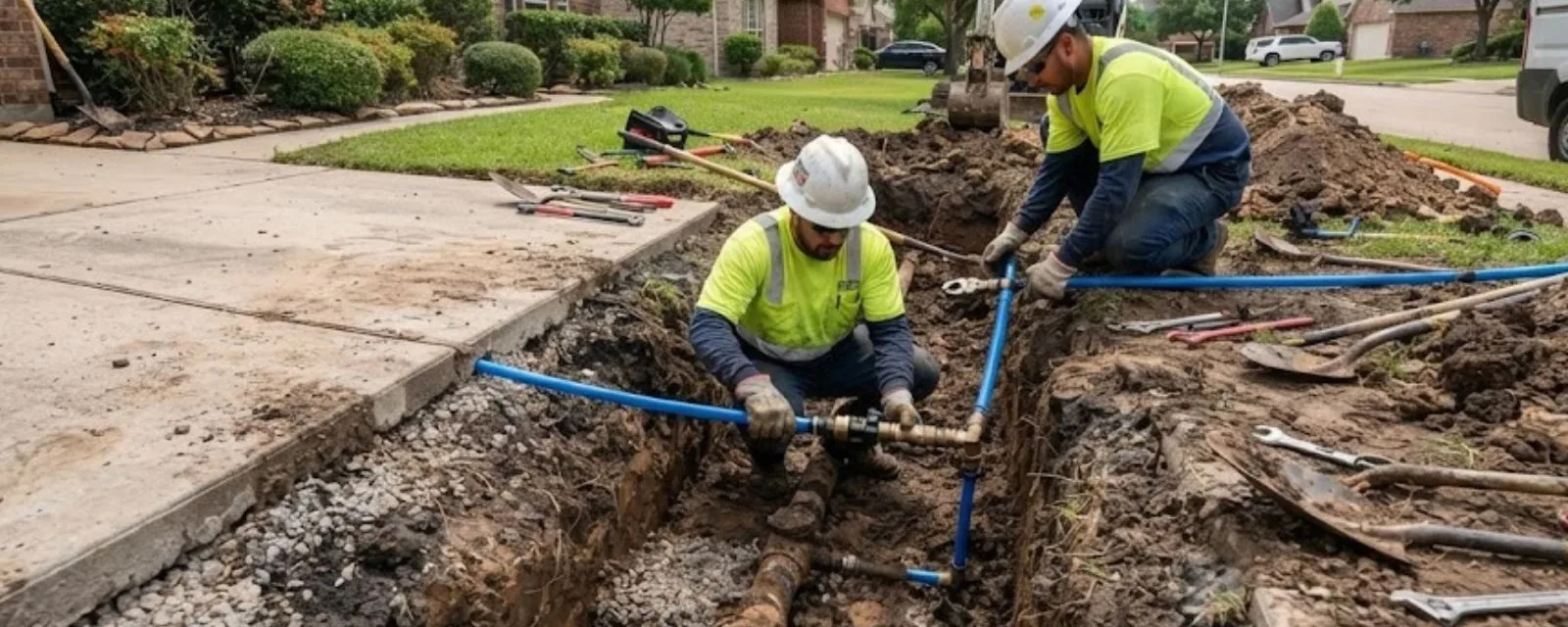
Water service line repair in Georgetown, KY covers the one pipe most owners never see: the buried line that carries water from the meter or curb stop to your house. When it cracks or corrodes, the symptoms show up as weak pressure, a wet patch in the yard or a meter that will not stop turning. We dispatch 24/7 for an active service line leak.
While you wait, close the main valve inside the house and check the meter. If the meter still moves with the house valve shut, the leak is outside and the utility can shut the water off at the meter. Keep children and pets off soft, pooled ground, since the soil around a broken line can wash out.
Low pressure, a soggy yard, a spinning meter: signs the buried line is failing
These symptoms have one thing in common, a problem between the street and the house. The pipe behind them is called the water service line, and it is repaired or replaced as its own job.
- Water pressure dropped at every fixture in the house at once.
- A strip of lawn stays soft, green or pooled while the rest is dry.
- The meter keeps turning after the house main is closed.
- You can hear water running or hissing near the front of the house with nothing on.
- The water bill rose without any change in use.
- Muddy or sandy water shows up after pressure changes.
How a water service line leak is found and fixed
The first test is the meter. With every tap off, a moving dial means water is leaving, and closing the house main separates a leak inside the walls from one in the buried line. When the meter keeps moving with the main closed, the leak sits between the meter and the house.
The technician then narrows the location with listening equipment on the line and, if needed, tracer gas, so the excavation is a short trench rather than a long guess. Kentucky 811 is called before any digging so buried gas, electric and utility lines are marked.
Once the break is exposed, the repair is a cut-out of a short section, much like a burst pipe repair indoors, or a longer replacement where the pipe is corroded along its length. The choice depends on what the exposed pipe looks like, and you see the options and the price before the trench is dug. The line is then pressure tested and the trench backfilled.
Water Service Line Repair: talk to a person now
Describe the problem and get a clear price before work starts.
Spot repair or full line replacement
Neither is always right. The condition of the pipe on both sides of the break decides.
A spot repair fits when
- The break is a single clean crack or a damaged joint.
- The rest of the pipe looks sound when exposed.
- The line is not corroded along its length.
- No earlier leak has been fixed on the same line.
Replacement fits when
- Several leaks have appeared on the same line.
- The pipe is badly pitted, scaled or crushed.
- The material is one you want gone, such as lead or old galvanized steel.
- The line is undersized for the house, and pressure is poor.
Low water pressure: where the problem really sits
Low pressure is a symptom, not a diagnosis. The pattern tells you whether the service line is the suspect or whether the cause is inside the house.
| What you notice | Likely place | What the technician checks |
|---|---|---|
| Weak at every fixture, hot and cold | Service line, main valve or pressure regulator | Meter test, valve position and pressure at an outdoor spigot. |
| Weak at one fixture only | Aerator, cartridge or supply stop | That fixture's own parts. |
| Weak on hot water only | Water heater or hot-side piping | Heater valves and sediment, plus hot lines. |
| Weak after a street repair | Utility main or air in the lines | Whether neighbors are affected, then your own filters and screens. |
| Weak in older homes at several fixtures | Corroded interior pipes | Interior piping, which is a repiping question. |
The last row belongs to a different job. Corroded lines inside the walls are handled under repiping, not under the buried service line.
Which utility serves you, and what is your line made of
Georgetown Municipal Water & Sewer Service (GMWSS) has completed a lead service line inventory that can be reviewed at its office. Ask GMWSS what material your service line is. If water has sat in the pipes a while, flushing for several minutes before drinking is the utility's own advice.
Kentucky American Water serves parts of northern Scott County instead. When a main broke there in November 2025, the neighborhoods saw low pressure and a boil water advisory, which shows why a pressure drop can be the utility's problem and not your pipe. Check with your own utility first, then test your line.
Permits and calling 811 before the trench
A new or replacement water service requires a plumbing installation permit under Kentucky's plumbing regulation, 815 KAR 20:050. Repairing a leak does not. The permit is issued to a licensed master plumber, or to a homeowner doing the work personally on the home they live in, and inspections happen before the work is covered.
That is why a short repair can be done in a visit, while replacing the line from the meter adds permit and inspection steps. Digging by anyone, including a homeowner, should always begin with a call to Kentucky 811 so the lines in your yard are marked first.
Service line or repiping: two different jobs
The service line is outside, underground and runs from the meter to the point where water enters the house. Repiping is the work inside, replacing the supply lines in the walls, floors and ceilings. A leak on one says nothing about the other.
A buried-line problem is usually fixed with a trench in the yard, while repiping means opening walls. If you are not sure where the leak sits, start with the meter test or a visit from leak detection, which separates the two before any digging is priced.
Wet ground at the meter box or curb
A meter box full of water or a soft spot at the curb could be a leak at the meter connection, which the utility handles, or on your side. Report it to the utility and describe what you saw. If the utility clears its own fitting, the problem is on the line to your house. We work the same way for homes in Midway and across the rest of our service area.
Pooling water right now: what to do while you wait
A broken service line can run all night and wash out soil, so these four steps keep the damage down until the technician arrives.
Close the house main
It will not stop a leak ahead of the valve, but it protects the plumbing inside.
Check the meter
Note the reading, then look again in 15 minutes with everything off to see if it moved.
Call the utility if needed
If the water keeps flowing, ask them to shut off at the meter. It is their equipment.
Mark and photograph the area
Show the wet spot and any sunken ground, and keep people and cars off it.
What drives the cost of service line work
Two yards on the same street can have very different jobs because of what lies between the meter and the house.
Coverage for buried-line failure varies, and many policies treat it separately from damage inside the house. Insurers generally pay for sudden loss rather than slow wear, so ask yours what applies.
Want your real number? Call (855) 575-2890.
Water Service Line Repair questions answered
A drop at every fixture usually points to the service line, a partly closed main valve, a pressure regulator or a utility problem. A meter test and a check of the valves narrow it down.
If neighbors are affected, call the utility first. A main break on its side is not a problem with your pipe.
Yes. A service line that starts leaking on a Saturday night gets the same 24/7 dispatch as a weekday call, and slower problems get same-day appointments when available.
Close the house main and call the utility if the water will not stop.
Ask your utility exactly where its responsibility ends, because the answer depends on the utility and the address. GMWSS serves the city and Kentucky American Water serves parts of northern Scott County. Generally, work on the house side of the meter is the owner's to arrange.
Yes. A new or replacement water service needs a plumbing installation permit under the state regulation, and repairing a leak does not. A licensed master plumber pulls it, or an owner-occupant working on their own home.
Ask GMWSS what material your service line is. The utility has completed a lead service line inventory that can be reviewed at its office. If your address is served by Kentucky American Water, ask that utility.
It might be, but water can travel before it surfaces. Check whether the meter moves with the house main closed, and call 811 before anyone digs. A technician can then listen along the line to find the break.
Where the local facts come from
According to these primary sources, which this page relies on for local facts, permit rules and published guidelines: