
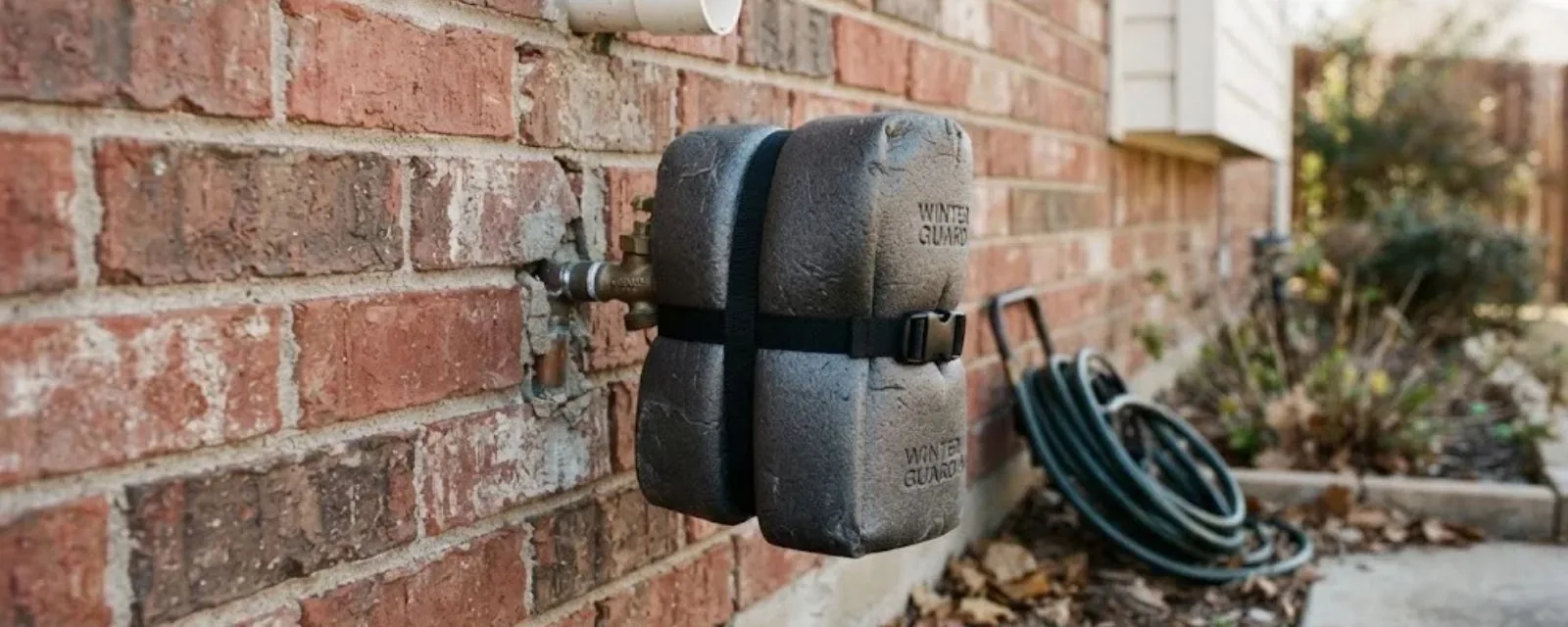
Outdoor faucet repair in Georgetown, KY starts with one question: where is the water coming from? A hose bib that drips at the handle, drips from the spout or leaks inside the wall each has a different cause and a different fix. The wall leak is the one to take seriously, because it can run for weeks before anyone sees it.
A hose bib is the outdoor spigot where you attach a garden hose, and a frost-free sillcock is the version built with a long stem so the shutoff sits inside the warm part of the house. This guide sorts the leaks by location, then covers how to keep the faucet from freezing and when a plumber should look at it.
Where the water shows up tells you what failed
Turn the hose bib on, then off, and watch carefully. Compare what you see with this table.
| What you see | Likely cause | Typical next step |
|---|---|---|
| Drip or spray around the handle when the water is on | Worn packing behind the handle | Snug the packing nut slightly, or replace the packing. |
| Steady drip from the spout when the faucet is off | Worn washer or seat inside the valve | Replace the washer, stem or the whole valve. |
| Water running down the wall inside or below the faucet | Split pipe or failed joint behind the wall | Shut off supply and call a plumber. |
| Spray from the vacuum breaker cap when running | Normal operation, or a worn breaker | Replace the breaker if it sprays constantly. |
| No water or a trickle after a cold snap | Frozen pipe near the faucet | Do not force it, thaw gently and check for splits. |
A drip of a few drops a minute adds up over weeks and shows up on your water bill, so a small leak is still worth fixing.
How many nights a year does a Georgetown-area hose bib face freezing?
The chart below shows the average number of days per month when the low temperature reaches 32 degrees or colder, based on the National Weather Service climate normals for Lexington, the closest official station. Look at where the bars start in the fall and where they fade in spring.
The months with the tallest bars are the ones where an attached hose or an undrained sillcock is most at risk. Plan the fall shutdown before the bars start climbing.
Rather have a licensed plumber look at it?
Call the 24/7 line. You get a clear price before work starts.
Why a hose left attached splits the pipe
Water expands as it freezes. A hose left on a hose bib holds water inside the faucet, so when it freezes the ice has nowhere to go and pushes back along the pipe. The pipe often splits inside the wall, where you cannot see it, and the damage only appears when you turn the water back on in spring.
A frost-free sillcock reduces that risk by placing the valve seat deep inside the wall. It still has to drain, which only happens if the hose is off and the faucet slopes slightly downward toward the outside. Check the installation instructions for your model, because a faucet that cannot drain is no better than an ordinary one.
Winterizing an outdoor faucet, step by step
These steps take a few minutes per faucet and can prevent a wall leak.
Disconnect every hose
Remove hoses, splitters and sprayers, and drain them before storing.
Look for a shutoff inside
Some homes have an interior valve for each outdoor faucet. Closing it and opening the outside tap to drain is the standard method.
Open the outdoor faucet
Leave it open so any water left in the line can escape. A covered faucet cap helps block cold wind.
Check for drips in spring
Turn the water on slowly and look at the wall around the faucet. Any moisture means the pipe may have split.
Repair the faucet or replace it?
Age and condition usually settle this question.
Repair when
- The leak is only at the handle or spout.
- The faucet body is sound and not corroded.
- Replacement parts are available for the model.
- There is no sign of water behind the wall.
Replace when
- The valve has leaked after earlier repairs.
- The body is cracked or heavily corroded.
- The faucet is an old style without frost protection.
- A freeze has already split the pipe.
Fall and spring faucet inspection
Walk the outside of the house twice a year with this list.
- Disconnect and drain every hose before the first hard freeze.
- Look for stains or soft spots on the siding under each faucet.
- Check basement or crawlspace ceilings near the faucet for damp spots.
- Open each faucet slowly in spring and watch for sprays or drips.
- Confirm the faucet runs with full pressure.
- Replace any faucet that drips from the spout and will not stop.
When to call a licensed plumber about an outdoor faucet
Call if water is showing inside the wall, in the basement under the faucet or along the foundation. A leak you cannot see needs a plumber who can find where it starts, and our leak detection service is built for that. Call too if the faucet needs replacing and the pipe behind it is damaged, because that becomes a burst pipe repair job.
We serve Georgetown homes and also Midway and the other towns on our service area map. Replacing or repairing the faucet is simple, but a split pipe behind brick or siding is not a casual job.
Georgetown, KY local note: freezing nights and your hose bib
At Lexington, the nearest National Weather Service climate station, the 1991 to 2020 normals show 89.9 days a year with a low at or below 32 degrees. January leads with 22.7 days, and November already brings 11.0. The consequence is practical: disconnect hoses by early November, not after the first frost warning.
Freezing is common into spring as well, with April still averaging 2.9 such days. Keep the faucet drained until the stretch of freezing nights has passed, and check for wet siding or basement ceilings when you turn it back on.
Questions readers ask
A drip at the hose connection usually means a worn washer inside the hose end, not the faucet. Replace the hose washer first. If it still drips at the spout, the valve seat is worn.
No. It resists freezing because the valve sits inside the warm wall, but it can still split if a hose traps water or the faucet cannot drain. Remove hoses every fall.
Yes, a small turn of the packing nut often stops a handle leak. Tighten it gently, since too much force makes the handle hard to turn and can damage the stem.
Look for water running down the wall, damp drywall inside or a wet spot below the faucet in a basement or crawlspace. Turn the water off at the supply and call a plumber.
It depends on the policy. Insurers generally pay for sudden, accidental loss, and they may view a freeze with a hose left on as preventable. Ask your insurer before you file.
Before November. Lexington's weather records show an average of 11.0 freezing-low days in November alone. Taking hoses off in October keeps you ahead of the first hard freeze.
Where the local facts come from
According to these primary sources, which this page relies on for local facts, permit rules and published guidelines: